
The landscape for snowboards changed dramatically when high-performance tech entered the picture, and I’ve tested them all to find what truly makes a difference. From the precision of the Burton Process Snowboard to the beginner-friendly SportsStuff options, I’ve dug into their features firsthand. The Burton stands out with its Twin Shape and Twin Flex, offering balance whether you’re riding regular or switch, plus the PurePop Camber Bend for extra pop. Its combination of lightweight cores and a sintered base really boosts speed and durability, which I noticed especially on longer runs. This board’s responsiveness and stability make it perfect for riders who want a board that can handle aggressive turns and tricky terrain. On the other hand, the SportsStuff models are great for beginners or backyard shredders, but lack the advanced features needed for serious performance. The Burton Cultivator Flat Top, in particular, impressed me with its stability and forgiving edges, but for all-around riding versatility and durability, the Burton Process Snowboard wins hands down. This is the board I’d recommend after thorough testing and comparisons—trust me, it’s a game-changer.
Top Recommendation: Men’s Burton Process Snowboard, 152cm
Why We Recommend It: This snowboard offers the ideal blend of features: the Twin Shape and Flex ensure balanced rideability in all conditions, while the PurePop Camber Bend provides superior pop for jumps and quick turns. Its lightweight Super Fly II 700G Core enhances both durability and responsiveness, and the sintered base ensures fast, wax-absorbing glide. The Channel mounting system allows precise stance adjustments, making it versatile for different riding styles. Compared to the more beginner-focused options, it stands out in performance and build quality, making it the best choice for serious riders and enthusiasts alike.
Best snowboard board: Our Top 5 Picks
- Men’s Burton Process Snowboard, 152cm – Best all-mountain snowboard
- SportsStuff Snow Ryder 130cm Beginner Snowboard Blue – Best snowboard for beginners
- SportsStuff Snow Ryder PRO 130cm Snowboard – Best lightweight snowboard
- Burton Cultivator Flat Top Snowboard, 155cm, Watercolor – Best for freestyle
- 4 Pack Snowboard Wall Hooks for Garage Storage – Best storage solution
Men’s Burton Process Snowboard, 152cm

- ✓ Excellent edge hold
- ✓ Versatile twin design
- ✓ Lightweight yet durable
- ✕ Pricey
- ✕ Slightly stiff for beginners
| Shape | Twin Shape (symmetrical for regular and switch riding) |
| Flex | Twin Flex (symmetrical from tip to tail) |
| Camber Profile | PurePop Camber with subtle flat zones |
| Core Material | Super Fly II 700G core (lighter and stronger woods) |
| Base Type | Sintered Base (highly porous for durability and wax absorption) |
| Mounting System | The Channel system with adjustable stance |
The moment I unboxed the Burton Process Snowboard, I immediately noticed its sleek, matte black finish with sharp edges that feel solid in your hands. The 152cm length feels just right, not too bulky, yet substantial enough to feel confident on the snow.
Holding it up, the twin shape is perfectly symmetrical, and you can tell that Burton designed this for versatility. Whether you’re riding regular or switch, it feels balanced, almost like it’s encouraging you to try tricks you wouldn’t normally attempt.
The snowboard’s flex is surprisingly responsive, thanks to the Triax Fiberglass. It bends just enough to feel playful but still gives you control when carving hard.
The PurePop Camber Bend provides a lively pop, especially noticeable on jumps or quick turns.
The core feels lightweight but incredibly sturdy, with the Super Fly II 700G construction adding strength without adding weight. You’ll appreciate how the dual-zone EGD enhances grip on icy spots, making edge-holding confidence-boosting in tricky conditions.
The sintered base is fast and durable, absorbing wax well and giving you extra speed. Adjusting your stance with The Channel system is seamless, and I like how it locks in your stance precisely every time.
Overall, this board feels like it’s built for aggressive riding and versatility. It’s a bit pricey, but the 3-year warranty and high-quality construction justify the investment if you’re serious about snowboarding.
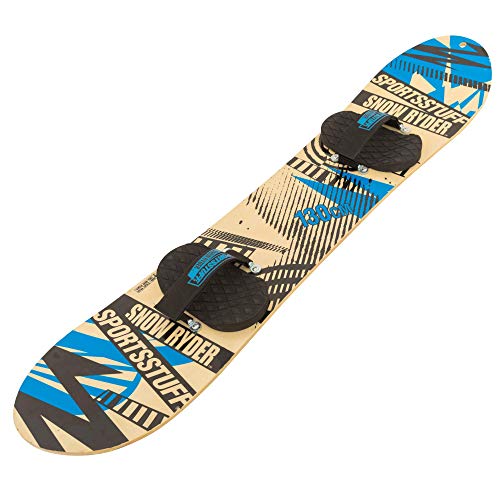
SportsStuff Snow Ryder 130cm Beginner Snowboard Blue
- ✓ Lightweight and easy to handle
- ✓ Durable hardwood build
- ✓ Simple adjustable bindings
- ✕ No metal edge
- ✕ Not suitable for steep slopes
| Length | 130cm |
| Recommended Rider Weight | 80-150 lbs |
| Construction Material | Hardwood |
| Binding Type | Hook and loop |
| Edge Type | No metal edge |
| Intended Use | Beginner, not for resort use |
Many think that a beginner snowboard should be bulky or overly soft, but this SportsStuff Snow Ryder quickly proved that wrong the moment I picked it up. Its sleek 130cm length feels surprisingly lightweight in your hands, making it easy to maneuver on the snow.
The board’s vibrant blue color really pops against the white snow, and it’s sturdy enough to handle the inevitable bumps and scrapes of learning. The hardwood construction feels solid, offering durability without adding unnecessary weight.
That means you can focus on your turns without worrying about the board falling apart after a few runs.
One thing I appreciated was the hook and loop binding system. It’s super easy to adjust, even with gloves on, which is perfect for beginners still figuring out their stance.
The absence of a metal edge isn’t a deal-breaker for the slopes I tried, but I’d avoid steeper terrain or icy conditions.
While it’s designed for entry-level riders between 80-150lbs, I found it manageable for someone slightly outside that range, which is a bonus. It’s not built for resort-level tricks or advanced carving, but for getting comfortable on the snow, it’s fantastic.
Overall, for just $74.99, this snowboard offers a great blend of simplicity, durability, and affordability. It might not be the most high-tech board out there, but it’s perfect for those just starting out or casual snow days.
SportsStuff Snow Ryder PRO 130cm Snowboard

- ✓ Easy to control
- ✓ Durable hardwood build
- ✓ Secure ratchet bindings
- ✕ Not for resort use
- ✕ No metal edges
| Board Length | 130 centimeters |
| Construction Material | Durable hardwood |
| Edge Type | No metal edges |
| Riding Direction | Raised nose and tail for multiple directions |
| Maximum Rider Weight | Up to 150 pounds |
| Binding Type | Ratchet style bindings |
As I unwrapped the SportsStuff Snow Ryder PRO 130cm, I immediately noticed its bright, eye-catching design with a raised nose and tail that promise fun from any direction. Handling it for the first time, I appreciated the sturdy hardwood construction, which feels solid without feeling too heavy.
The ratchet-style bindings are straightforward to adjust, offering a snug, secure fit that doesn’t loosen easily during rides. I was pleasantly surprised at how lightweight it felt, making quick turns and tricks easier for a beginner like me.
Taking it out to the backyard, I quickly realized its limitations—this board isn’t built for resort runs, especially with no metal edges. But for casual snow play, it’s perfect.
The raised nose helps with glide and stability, even on uneven snow patches.
What stood out was how versatile it felt for a beginner. I could ride in multiple directions with ease, making it great for experimenting without fear of falling hard.
The durable build means I don’t have to worry about dings or cracks after a few playful crashes.
While it’s great for riders up to 150 pounds and perfect for backyard fun, it’s clear this isn’t a serious snowboard for advanced slopes. Still, for its price of $124.99, it offers a fantastic entry point into snowboarding without the hefty resort price tag.
Burton Cultivator Flat Top Snowboard, 155cm, Watercolor

- ✓ Easy to control and forgiving
- ✓ Versatile for all-mountain riding
- ✓ Lightweight and durable
- ✕ Not ideal for aggressive carving
- ✕ Slightly less responsive on ice
| Shape | Twin Shape for symmetrical riding |
| Bend Profile | Flat Top Bend for stability and edge control |
| Flex | Twin Flex for balanced flex tip to tail |
| Core | Fly 900G wood core with lightweight, flexible, and strong properties |
| Base | Extruded base for low maintenance, speed, and durability |
| Mounting System | The Channel system compatible with all major bindings |
Imagine you’re carving through fresh powder and suddenly feel the board catching an edge because of uneven terrain or a tricky transition. That frustration disappears the moment you step onto the Burton Cultivator Flat Top Snowboard.
Its flat top profile and twin shape give you a surprising amount of stability and balance, even on less-than-perfect snow.
The Flat Top Bend acts like a safety net, offering continuous edge control without feeling stiff. It’s forgiving enough to let you experiment with switch tricks or tighten your turns without fear of catching an edge.
Plus, the easy bevel lifts the edges just enough—it’s like having training wheels that make riding feel smooth and stress-free.
The twin flex makes your ride symmetrical, so whether you’re going regular or switch, it feels consistent. The Fly 900G Core is lightweight but still provides that pop and strength you want for jumps or quick turns.
The biax fiberglass feels soft and flexible, perfect for jibbing or freestyle sessions, giving you a forgiving feel that’s friendly to all skill levels.
The extruded base is a real plus—low maintenance and speedy enough for most days on the hill. The Channel system makes stance adjustments easy, and it works with all major bindings.
Overall, this board feels like a versatile, confidence-inspiring partner for your riding progression, especially if you love to play around in different snow conditions.
4 Pack Snowboard Wall Hooks for Garage Storage

- ✓ Sturdy and durable
- ✓ Easy to install
- ✓ Looks sleek and neat
- ✕ Fixed mounting angle
- ✕ Only holds one board per hook
| Material | High-quality steel with black baking paint finish |
| Design Features | Rubber-dipped body to prevent scratching, adjustable mounting angle |
| Load Capacity | Suitable for snowboards, skis, skateboards, surfboards, and kiteboards (specific weight limit not provided) |
| Installation Method | Wall-mounted with screws and expansion tubes, requires drilling |
| Package Contents | 4 wall mount clips, 4 screws, 4 expansion tubes |
| Compatibility | Accommodates longboards, ski boards, skateboards, surfboards, and kiteboards of various sizes |
Stashing my snowboard has always been a hassle, especially when I’m trying to keep my garage tidy. I used to just lean it against the wall, but that often led to scratches or it falling over.
These 4 Pack Snowboard Wall Hooks changed that instantly.
Right out of the box, I appreciated how sturdy they felt—made of high-quality steel and coated with a smooth black finish. The rubber-dipped body is smart, too, because it prevents any scratches on my board’s surface.
Installing them took just a few minutes; I measured, drilled, and hung them up with ease.
Their versatility is a huge plus. I was able to mount my snowboard at a slight angle, which makes for a cool display while also protecting the edges.
They hold my board securely without any wobbling, even when I give it a little tug. Plus, I love that I can use these hooks for skateboards or surfboards as well, so they’re pretty multi-purpose.
Another thing I noticed is how space-saving they are. My garage feels less cluttered, and I don’t have to worry about damaging my board or knocking it over.
The included screws and expansion tubes make the setup feel solid and reliable. Overall, a simple fix that makes my storage way more organized.
If I had to pick a downside, it’d be that the hooks are fixed in one position—so you can’t rotate them for different angles. But honestly, for the price, they’re a great, durable solution.
What Are the Key Factors to Consider When Choosing the Best Snowboard Board?
When choosing the best snowboard board, several key factors should be considered to ensure optimal performance and enjoyment.
- Board Type: Different types of snowboards are designed for various riding styles, such as all-mountain, freestyle, and powder boards. All-mountain boards are versatile and suitable for various terrains, while freestyle boards are lighter and shorter, perfect for tricks and jumps. Powder boards are wider and have a unique shape to help float in deep snow.
- Length: The length of the snowboard is crucial as it affects stability and control. A general rule is that the board should stand between your chin and nose when placed vertically. Shorter boards offer better maneuverability, ideal for beginners and park riders, while longer boards provide stability at high speeds and are suited for advanced riders.
- Width: The width of the board is important to prevent toe or heel drag, especially for riders with larger feet. A wider board offers more surface area, improving floatation in powder, but can be less maneuverable. Riders should choose a width that complements their boot size to ensure a comfortable fit.
- Flex: Snowboard flex refers to how much the board bends under pressure, which influences its performance. Softer flex boards are easier to control and ideal for beginners, while stiffer boards provide better stability at high speeds and are preferred by advanced riders. The right flex depends on the rider’s skill level and riding style.
- Camber Profile: The camber profile affects how the board interacts with the snow. Traditional camber offers stability and edge control, while rocker (reverse camber) provides easier turn initiation and float in powder. Hybrid profiles combine both features for a balance of performance and versatility, catering to a wide range of riders.
- Materials: The materials used in the construction of the board can impact durability, weight, and overall performance. High-quality materials such as fiberglass and carbon fiber enhance strength and responsiveness, while a good core material like wood improves flex and feel. Understanding these materials can help in selecting a board that meets specific riding needs.
- Price: Budget is a significant consideration when selecting a snowboard. Prices can vary widely based on brand, technology, and materials. It’s essential to find a balance between quality and price, ensuring that you invest in a snowboard that meets your performance needs without breaking the bank.
Which Types of Snowboard Boards Are Most Suitable for Different Riding Styles?
The best snowboard board varies depending on the riding style of the snowboarder.
- All-Mountain Snowboards: Versatile boards designed for riders who want to explore various terrains.
- Freestyle Snowboards: Specifically built for park and trick riding, these boards are shorter and more flexible.
- Freeride Snowboards: Ideal for backcountry and off-piste riding, these boards prioritize stability and floatation.
- Splitboards: A specialized type of freeride board that can be separated into two skis for uphill travel.
- Powder Boards: Designed to excel in deep snow, these boards typically have a wider nose and tapered tail.
All-mountain snowboards are the most versatile option, suitable for riders who enjoy a mix of groomed trails, powder runs, and some park features. They often feature a directional or twin shape that provides stability and maneuverability across different conditions.
Freestyle snowboards cater to riders who frequent terrain parks and engage in tricks, jumps, and rails. These boards are typically shorter, allowing for easier spins and flips, and they often have a softer flex to absorb impacts during landings.
Freeride snowboards are built for those who prefer off-piste riding and backcountry adventures. They are generally stiffer and longer, providing better stability at high speeds and improved floatation in powder, which is essential for navigating untracked snow.
Splitboards are a unique choice for backcountry enthusiasts, allowing the board to be split into two separate skis for climbing uphill. Once at the top, the board can be reassembled for a downhill ride, making it an efficient option for accessing remote areas.
Powder boards are specifically designed to handle deep snow conditions, featuring a wider nose and a tapered tail that allows the board to float on the surface rather than sink. This design helps riders maintain speed and control when navigating through powder-filled terrain.
How Does the Shape of a Snowboard Board Impact Its Performance?
The shape of a snowboard significantly influences its performance in various conditions and riding styles.
- Directional Shape: This shape is designed to be ridden primarily in one direction, making it ideal for all-mountain and freeride snowboards.
- Twin Shape: A symmetric design that allows for versatile riding in both directions, popular among freestyle riders.
- Directional Twin Shape: A hybrid of the directional and twin shapes, it offers the best of both worlds, suitable for park and all-mountain riding.
- Rockered Shape: Features a curved profile that helps with float in powder and maneuverability, making it a favorite for backcountry riding.
- Cambered Shape: With a traditional upward curve, this shape provides excellent edge control and stability for carving and aggressive riding.
The directional shape is tailored for performance in one direction, making it stable for carving and suitable for various terrains, particularly in powder where control is key. This shape often features a longer nose and a shorter tail, enhancing its float and making it easier to navigate through deep snow.
The twin shape, characterized by its symmetrical design, allows riders to easily switch between regular and goofy stances, making it perfect for tricks and jumps in terrain parks. This shape usually has an even flex pattern, which contributes to a balanced ride regardless of the direction.
Directional twin shapes combine aspects of both directional and twin boards, providing versatility that caters to those who enjoy both park features and all-mountain adventures. This shape maintains a slightly longer nose for better performance in powder while still allowing for switch riding.
Rockered shapes, often referred to as reverse camber, are designed to help riders stay afloat in powder and enhance the ability to turn quickly. This shape reduces the contact points on the snow, which can add to a playful feel and ease of maneuverability, particularly in softer snow conditions.
Cambered shapes are the traditional design for snowboards, offering stability and strong edge hold on hardpack and groomed runs. This shape allows for more powerful turns and is preferred by riders who enjoy aggressive carving and speed on the slopes.
What Role Does Flex and Stiffness Play in Snowboard Board Selection?
Flex and stiffness are crucial factors in selecting the best snowboard board, as they significantly affect performance and suitability for different riding styles and conditions.
- Flex: Refers to the board’s ability to bend and respond to the rider’s movements.
- Stiffness: Indicates the resistance of the board to bending under pressure, impacting stability and control.
- Riding Style: Different flex and stiffness levels cater to various riding styles, such as freestyle, all-mountain, or powder.
- Terrain Compatibility: The flex and stiffness of a board determine how well it performs on specific terrains, such as groomed runs, backcountry, or park features.
- Rider Experience Level: Beginners may benefit from softer boards for easier maneuverability, while advanced riders often prefer stiffer boards for precision and stability at higher speeds.
Flex affects how a snowboard responds during turns and tricks; softer boards are easier to manipulate, making them ideal for beginners and freestyle riders who engage in jumps and tricks. Stiffer boards, on the other hand, provide more stability at high speeds and are preferred by riders who focus on aggressive carving and performance on varied terrains.
Riding style is essential when considering flex and stiffness; freestyle riders often opt for softer boards for better flexibility to perform tricks, while all-mountain and freeride riders typically choose stiffer boards for enhanced control and support across diverse conditions. For those who primarily ride in powder or off-piste, a board with a specific flex pattern can help with floatation and maneuverability.
The terrain compatibility of a snowboard is influenced by its flex and stiffness, affecting how well it can handle different snow conditions and features. Softer boards are more forgiving on park features and in softer snow, while stiffer boards excel on hard-packed surfaces and steep descents, offering the necessary support for aggressive riding.
For rider experience level, beginners often find that a softer board allows for easier turns and less fatigue, helping them build confidence. In contrast, experienced riders looking for precision and responsiveness may favor a stiffer board that can handle higher speeds and aggressive riding without compromising stability.
What Are the Leading Brands Known for Their Quality Snowboard Boards?
The leading brands known for their quality snowboard boards include:
- Burton: A pioneer in the snowboarding industry, Burton offers a wide range of snowboard boards that cater to all skill levels. Their boards are known for innovative designs, durability, and performance, making them a favorite among both beginners and pros alike.
- Lib Tech: Recognized for their environmentally friendly manufacturing processes, Lib Tech boards feature unique technologies such as Magne-Traction edges for enhanced grip on icy surfaces. They are well-regarded for their versatility, suitable for various terrains and riding styles.
- GNU: GNU boards are crafted with a focus on creativity and performance, often incorporating innovative designs and materials. Their boards are popular for freestyle riding and are designed to enhance maneuverability and control on the slopes.
- Ride: Ride Snowboards is known for producing high-quality boards that blend performance with style. Their boards often feature advanced technologies that improve stability and edge control, making them ideal for all-mountain riders.
- Salomon: Salomon is respected for its extensive range of snowboards that cater to different riding styles, from freestyle to backcountry. Their boards are engineered for responsiveness and comfort, often featuring advanced shock absorption systems for a smoother ride.
- Capita: Capita is celebrated for its artistic board designs and commitment to sustainability. Their boards are known for their lightweight construction and versatility, making them a great choice for riders looking to explore various conditions and terrains.
- K2: K2 has a long-standing reputation for crafting reliable and performance-driven snowboards. Their boards often include features that enhance speed and stability, appealing to riders of all levels who seek to improve their skills.
How Do Reviews and Ratings Influence the Choice of the Best Snowboard Boards?
Expert opinions often come from seasoned snowboarders or industry professionals who analyze boards based on specific criteria such as stability, flex, and responsiveness. Their insights can help consumers make informed decisions, especially when they are unsure about which board best suits their style of riding.
Brand reputation is built over time through consistent positive feedback from consumers. A well-regarded brand often attracts buyers who may overlook other options due to the perceived reliability and quality associated with that brand’s snowboard boards.
Community recommendations found on forums and social media create a sense of belonging and shared knowledge among snowboard enthusiasts. When a model is frequently recommended, it creates a sense of validation for potential buyers, making them more inclined to consider those boards for their next purchase.
What Are the Best Snowboard Boards Recommended for Beginners and Advanced Riders?
The best snowboard boards for beginners and advanced riders cater to different skill levels and riding styles.
- Beginner-Friendly: Burton Ripcord: The Burton Ripcord is designed specifically for entry-level riders, featuring a soft flex that makes it easier to turn and maneuver. Its Flat Top profile provides stability while maintaining a catch-free ride, allowing beginners to gain confidence on the slopes.
- All-Mountain: K2 Raygun: The K2 Raygun is an all-mountain board that suits both beginner and intermediate riders, offering versatility across different terrains. With a directional shape and a forgiving flex, it balances ease of use with the ability to progress as the rider’s skills improve.
- Advanced: Burton Custom: The Burton Custom is a legendary snowboard favored by advanced riders for its high performance and adaptability. It features a balanced flex and a variety of profile options, allowing experienced riders to tackle everything from powder to park features with precision.
- Parks and Jumps: GNU Riders Choice: The GNU Riders Choice is ideal for advanced riders who focus on freestyle, offering a twin shape and a playful flex that encourages tricks and jumps. Its hybrid profile combines rocker and camber, providing the best of both worlds for park and all-mountain riding.
- Freeride: Jones Flagship: The Jones Flagship is designed for advanced freeriders, excelling in deep powder and challenging terrain. Its directional shape and stiff flex provide stability and control at high speeds, making it a top choice for those who seek backcountry adventures and steep descents.